
The Simplifi API authenticates using OAuth 2.0 with the client credentials grant flow. This is a machine-to-machine flow designed for server-side integrations. Your server exchanges a Client ID and Client Secret for a short-lived access token (1 hour), which is then used to authenticate the API request. To obtain your Client ID and Client Secret:
  1. Press Integrations under Our Profile
  2. Press Explore APIs
  3. Press the select button for the Simplifi API
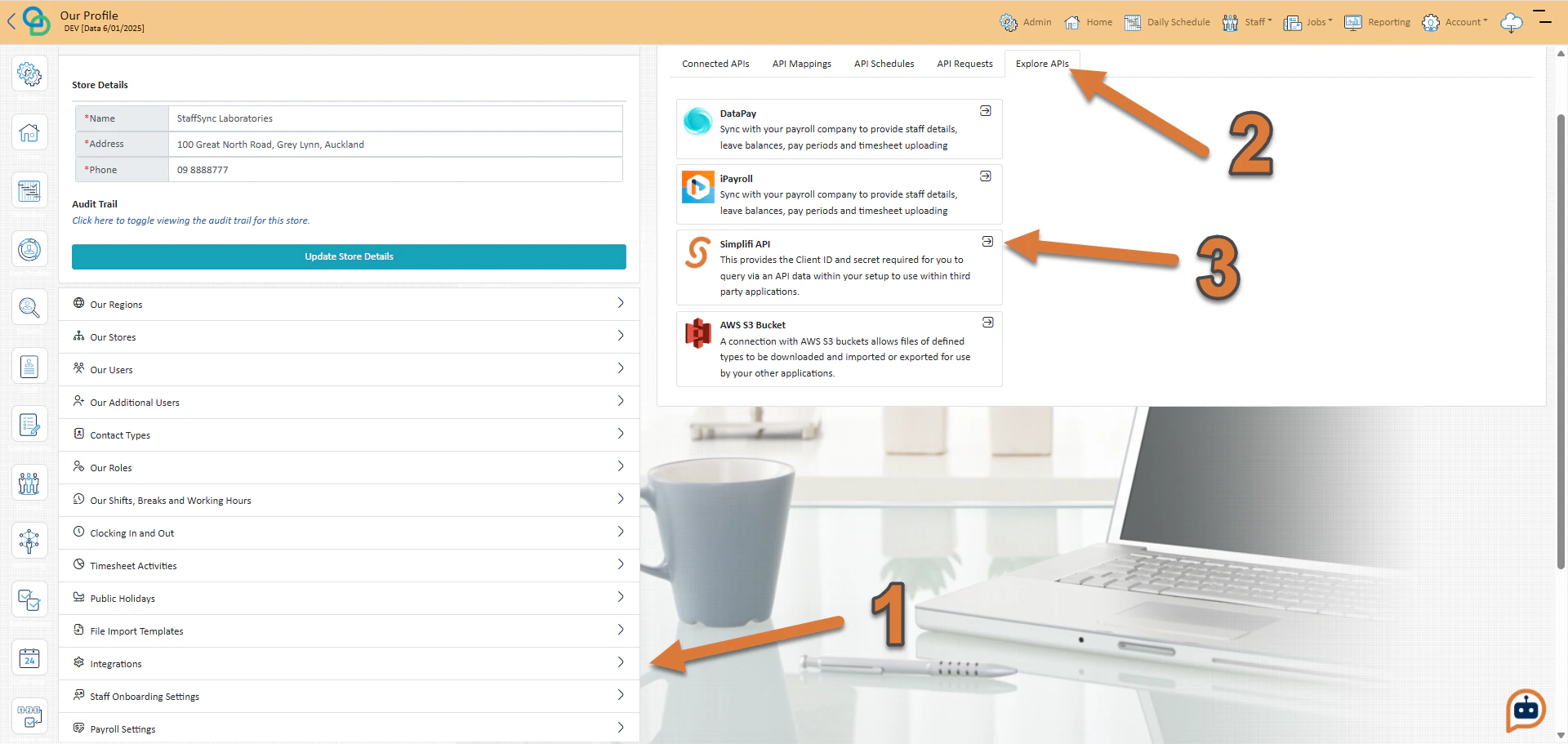
You will now see the Client ID, Client Secret as well as the Base URL and Authorisation URL.
2026 04 08 15 54 52

Tokens

OAuth 2.0 works by passing your Client ID, Client Secret to the authentication server in exchange for a short-lived access token. This token represents your application and must be included in the Authorization header of every API request.
OAuth 2.0 Tokens expire exactly 1 hour after they are generated for you
When a token expires, simply repeat the authentication request to receive a new one. We recommend that you build a token manager in your application that caches the token and automatically re-authenticates when a 401 response is received. A successful authentication request returns a JSON response like this:
JSON
{"__type":"SSJSON_Token_Access","access_token":"example_access_token","expires_in":3600,"refresh_token":"example_refresh_token","scope":"read","token_type":"Bearer"}

Example: Requesting Employees using a Token Manager

You can see an example of a token manager in Python below:
python
import time
import requests

CLIENT_ID = "your_client_id"
CLIENT_SECRET = "your_client_secret"
AUTH_URL = "https://dev.simplifi.work/oauth/token"
BASE_URL = "https://dev.simplifi.work/api"

class SimplifiClient:
    def __init__(self, client_id: str, client_secret: str):
        self.client_id = client_id
        self.client_secret = client_secret
        self._token: str | None = None
        self._token_expiry: float = 0

    def get_access_token(self) -> str:
        response = requests.post(
            AUTH_URL,
            data={"grant_type": "client_credentials"},
            auth=(self.client_id, self.client_secret),
        )
        response.raise_for_status()
        data = response.json()
        self._token = data["access_token"]
        # Subtract 30 seconds as a buffer so we refresh slightly before 			 expiry
        self._token_expiry = time.time() + data["expires_in"] - 30
        return self._token

	# Is the token expired? if so _get_access_token
    def get_valid_token(self) -> str:
        if self._token is None or time.time() >= self._token_expiry:
            self.get_access_token()
        return self._token

    def request(self, method: str, path: str, **kwargs) -> dict:
        token = self.get_valid_token()
        response = requests.request(
            method,
            f"{BASE_URL}{path}",
            headers={"Authorization": f"Bearer {token}"},
            **kwargs,
        )
        if response.status_code == 401:
            # Token rejected by server — force a refresh and retry once
            self._token = None
            token = self._get_valid_token()
            response = requests.request(
                method,
                f"{BASE_URL}{path}",
                headers={"Authorization": f"Bearer {token}"},
                **kwargs,
            )
        response.raise_for_status()
        return response.json()

    def get_employee(self, employee_id: str) -> dict:
        return self.request("GET", f"/v1/employees/{employee_id}")

    def get_employees(self) -> list:
        return self.request("GET", "/v1/employees")


# Usage
client = SimplifiClient(CLIENT_ID, CLIENT_SECRET)
employee = client.get_employee("123")
Note that when the request method in the SimplifiClient class is called, it gets a valid token by calling get_valid_token which checks if an hour has passed (minus 30 seconds) and if so, then it fetches a new, valid token by calling get_access_token .